Program totals
Invoices processed, reported claims, total loss adjustment expense and average invoice for the period.
Every VIP carrier program receives a Success Summary business review each quarter: invoice volume, reported claims, loss adjustment expense, average invoice and cost of service — with the workflows behind each number. The figures below are an anonymized example of a reporting period.
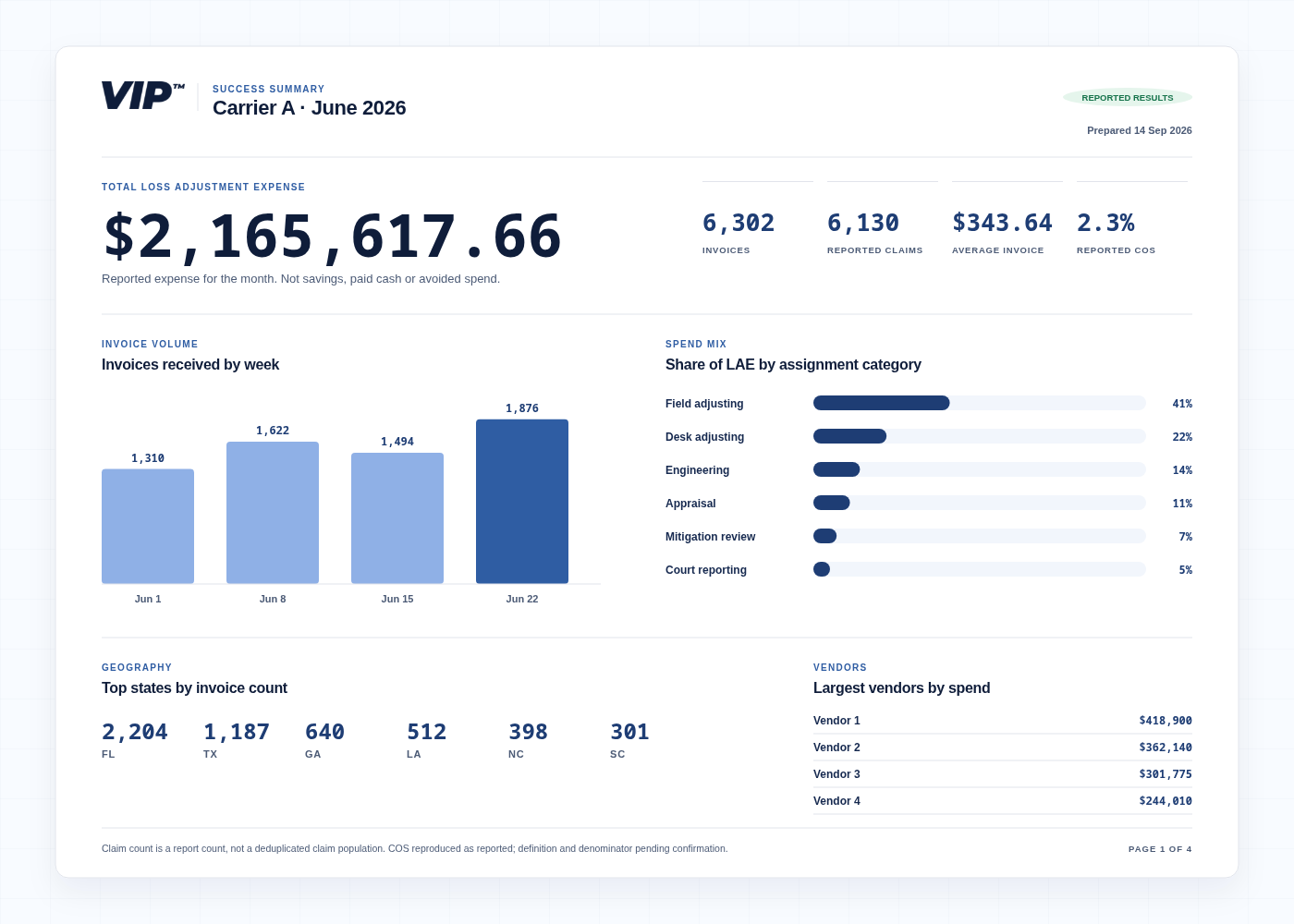
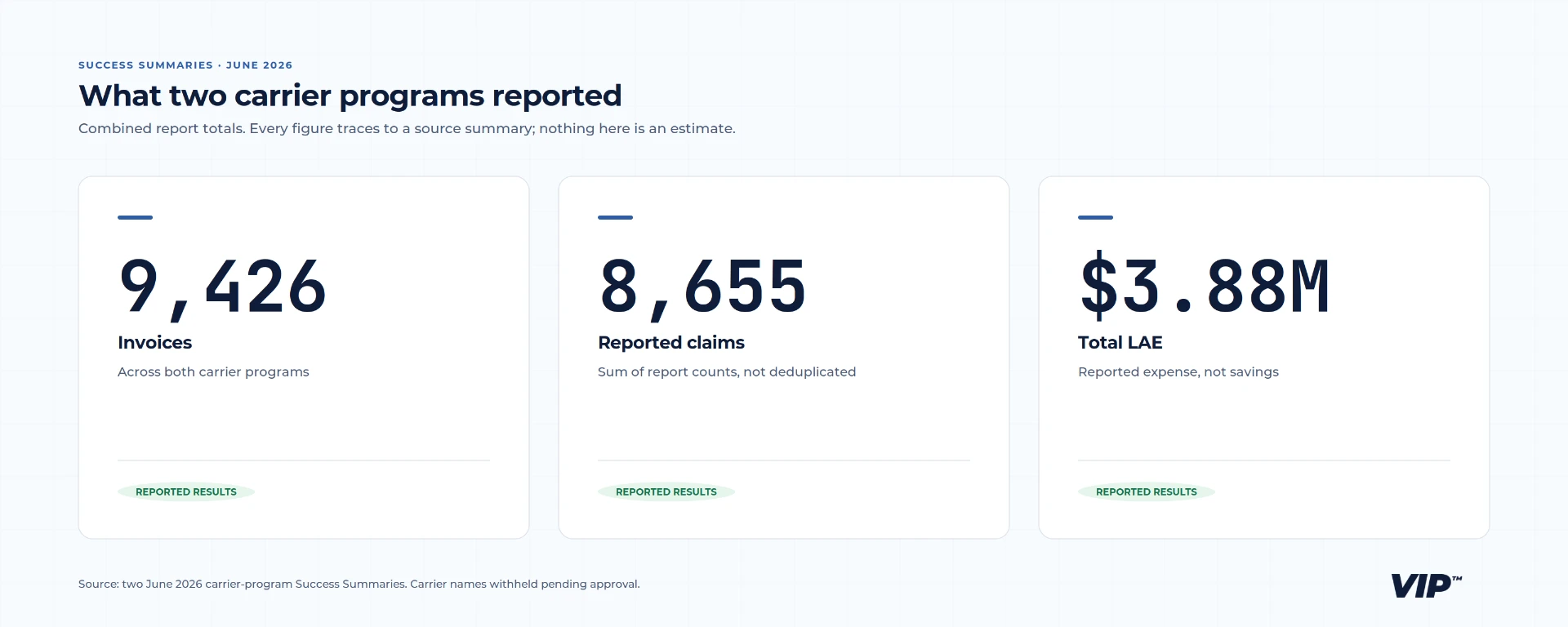
Loss adjustment expense is reported expense — not revenue, paid cash, identified avoided spend or savings. Claim counts are the sum of report counts rather than an independently deduplicated claim population. No causal ROI or before/after improvement is claimed from these reports.
Carriers are not identified. Naming requires written approval.
Delivered each quarter as a business review, walked through with your VIP team.
Invoices processed, reported claims, total loss adjustment expense and average invoice for the period.
Reported cost of service for the period, with the definition and denominator stated so period-to-period comparison is sound.
Where invoices moved, where they stalled, fallout and rework, and which steps carried the volume.
Activity and spend by provider, so sourcing and performance conversations start from the record.
Each quarter is added to your program history so movement is visible rather than reconstructed.
The report is walked through with your VIP contacts, with agreed follow-ups for the next period.
Each use case states the evidence behind it and the limit of that evidence. Reported results come from program summaries, customer narratives are qualitative, and product capability describes how the workflow runs rather than a measured outcome.
Problem. High invoice volume creates fragmented review and reconciliation.
Workflow. Consolidate intake, review status, vendor reporting and payment readiness in one workflow.
Evidence and limits. The June reports document 9,426 invoices and $3.88M in loss adjustment expense. This evidences reported throughput, not time saved.
How success is measured. Intake-to-approval time, touches per invoice, rework rate, cost per processed invoice.
Invoice review and reportingProblem. Spend is distributed across firms, service types and locations.
Workflow. Compare spend by vendor, assignment category and geography, then drill into the underlying population before taking sourcing action.
Evidence and limits. The reports contain vendor, category and state distributions, including engineering, appraisal, court reporting and mitigation review.
How success is measured. Spend coverage, off-panel share, concentration, category-normalized rates.
Vendors and reportingProblem. Bills must be checked against agreements while keeping claim and matter context.
Workflow. Normalize invoice data, match approved rates, flag exceptions and show budget and reserve context.
Evidence and limits. Documented workflow. No verified legal savings study is published here.
How success is measured. Substantiated adjustments, sustained appeal decisions, review time, budget variance.
Matters, rates and guidelines, invoice reviewProblem. Approved invoices and paid records become disconnected.
Workflow. Generate authorized payment files, then ingest remittance and link reference, date and amount back to each invoice.
Evidence and limits. Documented workflow. No measured reduction in payment errors is published here.
How success is measured. Unmatched payments, duplicate payments, reconciliation time, days from approval to paid.
Invoice payment status — payment execution stays separately authorizedProblem. Manual invoice-by-invoice work becomes a bottleneck when volume surges.
Workflow. Import templates, validate rows, review in batches and report per-row failures.
Evidence and limits. Supported by a catastrophe services customer narrative. Productivity gain is not quantified.
How success is measured. Invoices per staff hour, import error rate, billing backlog.
Invoice intakeProblem. Multi-level commissions, expenses and deductions require reconciliation.
Workflow. Calculate compensation under agreed rules and export payroll with invoice and claim references.
Evidence and limits. Described in an IA firm customer narrative. No measured payroll accuracy improvement is published here.
How success is measured. Adjustment rate, payroll preparation hours, payout disputes.
Provider-side workflowProblem. Users need the work relevant to them without unnecessary access or clutter.
Workflow. Scope queues by ownership and team, and enforce protected actions and authority server-side.
Evidence and limits. Supported by customer narratives on role-based access.
How success is measured. Time to first action, aged work, reassignment time, authorization failures.
Overview, intake and triageProblem. Contracts, specialties, rates and approval states drift out of alignment.
Workflow. Centralize vendor and office eligibility, agreements, panel decisions and versioned acknowledgements.
Evidence and limits. Documented workflow. Detailed office and specialty controls are requirements, not proven deployment.
How success is measured. Eligible assignments, missing agreements, expired documentation.
Vendors, rates and guidelinesProblem. Assignment performance has to be judged against the correct contract.
Workflow. Ingest milestone events, apply contract-specific SLA definitions and review scorecards and any proposed penalties or bonuses.
Evidence and limits. Documented workflow. Realized benefits were not measured in these sources.
How success is measured. Milestone completeness, on-time rate, disputed SLA decisions.
Assignments, lifecycle, reportingProblem. Separate systems require repeated data entry and reconciliation.
Workflow. Map billing, compensation and remittance to accounting records with retry and reconciliation controls.
Evidence and limits. Accounting and carrier or vendor API workflows are documented. Connection status is confirmed per customer.
How success is measured. Duplicate entry, reconciliation exceptions, posting latency, retry recovery.
Connections, invoice reviewProblem. A headline rate hides travel, complexity and responsibility differences.
Workflow. Benchmark comparable assignments by scope, geography and catastrophe conditions, and model margin separately.
Evidence and limits. Validated as a need in firm leadership interviews. Illustrative rates are not observed benefits.
How success is measured. Comparable sample coverage, negotiated rate changes, realized margin after costs.
Rate intelligenceProblem. Leaders need defensible answers rather than unsupported dashboard claims.
Workflow. Answer questions from traceable aggregates, expose the population and period, and separate live evidence from proposed capability.
Evidence and limits. Success summary outputs support throughput and spend questions. Population is validated before external use.
How success is measured. Sourced-answer coverage, aggregate reconciliation, decision adoption.
Reporting and intelligenceThe same invoice, vendor, category and geography detail that produces these summaries is what rateIQ benchmarks against. More processed volume means deeper comparables, so a rate conversation is supported by what similar assignments actually bill — scope, travel, complexity and catastrophe conditions included — rather than a headline number.
Invoice intake, review, vendor governance, SLA measurement, payment and reporting run in the same workflow, so the operational record that proves throughput is also the record that runs the work. That is what makes the reporting defensible: it is produced by the workflow, not assembled after it.